Showing posts with label Biographies. Show all posts

BIO: Buddy "Jack" Roberts

Real Name: Dale Hey

Hometown: Del City, Oklahoma

Height/Weight: 6'2"/235

Signature Moves: Russian leg sweep, swinging neckbreaker

WCCW Titles Held: NWA Texas Heavyweight title, WCCW TV title, WCCW Six-Man Tag Team titles (five times with Michael Hayes and Terry Gordy, once with Gordy and Iceman King Parsons)

Notable WCCW Feuds: The Von Erichs, Iceman King Parsons, Michael Hayes and Terry Gordy.

Need to Know Facts: Born Dale Hey in 1945, Buddy began his storied wrestling career in 1965 as Dale Valentine, the fictitious brother of the legendary Johnny Valentine.

Changing his name to Buddy Roberts in 1970 (the "Jack" nickname, a reference to his fondness for Jack Daniel's whiskey, came later in his career), Dale formed the original Hollywood Blonds with Jerry Brown, and they won numerous regional tag team titles across the United States throughout the '70s.  Toward the end of the decade, Buddy split from Brown, making his first stop in the Dallas-Fort Worth area during 1978.  Reverting back to the Dale Valentine gimmick, he was accompanied at ringside by Johnny Valentine, who was by then confined to a wheelchair due to the injuries he had suffered in a career-ending 1975 plane crash (which also sidelined the young Ric Flair for a brief period).  Though Dale proved to be a popular babyface during this time, Johnny was obviously able to do very little as his manager and the pairing was short-lived.

By the time the Fabulous Freebirds left the Mid-South promotion for Georgia in 1980, Roberts had joined the team at the suggestion of promoter Bill Watts.  Original members Michael Hayes and Terry Gordy immediately won a tournament for the Georgia Tag Team titles upon entering the territory, defeating Mr. Wrestling I & II (Tim Woods and Johnny Walker) and the Assassins (Jody Hamilton and Tom Renesto).  Eventually, however, Gordy and Roberts turned on Hayes, making him a fan favorite.  While Hayes and Gordy feuded, Roberts soon disappeared from the area.

In the fall of 1982, shortly after reuniting as babyfaces, Hayes and Gordy were fired by Georgia promoter Ole Anderson.  Hayes soon resurfaced in WCCW, immediately becoming wildly popular with D/FW area fans, and contacted Gordy and Roberts, urging them to join him in Texas.  Buddy arrived to reform the trio just as the Freebirds' historic feud with the Von Erich family was beginning. The rivalry would last off and on for nearly seven years.

In spring 1983, World Class fans first got the opportunity to appreciate the singles wrestling talents of Roberts when he clashed with the extremely popular "Iceman" King Parsons.  Their feud started when Buddy cut off a few of Iceman's trademarked braids, which naturally incensed Parsons.  The dastardly act would ultimately result in a hair vs. hair match at Reunion Arena, in which the loser would have his hair removed with the soon-to-become-infamous Freebird hair cream.  Buddy did win the match (albeit in a devious manner), but wound up losing his own hair as Parsons smeared the cream onto Buddy's scalp while his back was turned.  What followed was pure hilarity for World Class fans as Roberts would now attempt to deny the obvious and cover his dome with an obvious wig and boxing headgear while claiming that his hair had miraculously "grown back" overnight.

In addition to the Parsons feud, Buddy and his "brothers" Hayes and Gordy would go on to hold the prestigious Six-Man trophy on five separate occasions from 1983-1986, and the team would be a key factor in selling out World Class venues throughout the Southwest area during this time.

After another brief run in World Class during the first half of 1986, the Freebirds -- as did many other WCCW stars during this time -- entered Bill Watts' Universal Wrestling Federation with Sunshine as their manager. During their UWF stint, they feuded with The Fantastics (Bobby Fulton and Tommy Rogers), Ted DiBiase, "Dr. Death" Steve Williams, "Hacksaw" Jim Duggan, Terry Taylor and Watts.  On September 28, 1986, Roberts defeated Taylor for the UWF TV title in Oklahoma City.  Following the sale of the UWF to Jim Crockett Promotions in mid-1987, Buddy turned up in Ken Mantell's short-lived Wild West Wrestling group based in Fort Worth, ironically teaming with his former bitter enemy, Iceman King Parsons.

The Freebirds' final stint in World Class began in late 1987 as Wild West was absorbed into WCCW.  This run was unlike either of their previous WCCW stays, as Roberts and Iceman joined forces with Gordy and the Angel of Death, again feuding violently with Kevin and Kerry Von Erich after Fritz's notorious post-attack "collapse" at Reunion Arena.  Michael Hayes also returned early in 1988, but to the fans' surprise and delight, became an ally of the Von Erichs -- and his babyface turn was cemented after Roberts, during a concert performance by Hayes at the Sportatorium, clocked Michael with a solid-body electric guitar!

After Gordy left for Japan in mid-1988, Michael Hayes took on former UWF alumnus Steve Cox as his regular tag team partner, and Roberts became the manager for the vicious Samoan Swat Team. The two teams exchanged the WCCW World Tag titles on two different occasions.

After the World Class promotion dissolved, Roberts would make the occasional managerial appearance (managing Michael Hayes and Jimmy Garvin in a match against Steve Armstrong and Tracy Smothers in the NWA), but largely remained retired.  In the later 1990's, Buddy discovered he had developed throat cancer, which he attributed to many years of heavy smoking; however, he was treated successfully.

Buddy Roberts passed away on November 29, 2012.

BIO: Percy Pringle III

Real Name: William Moody
   
Hometown: Mobile, AL

Notable WCCW Feuds: Iceman Parsons, the Von Erichs, the Dingo Warrior, Chris Adams, Devastation Inc.

Need to Know Facts: Born William Alvin Moody in Mobile, Alabama on April 10, 1954, Percival (Percy) Pringle III was every bit as much a wrestling fan as he was a wrestling legend. Percy "got his foot in the door" via the Gulf Coast Wrestling promotion, where he served as a photographer during his high school years.

Upon his high school graduation, Percy joined the U.S. Air Force. While in the service (during which he had debuted as “Mr. X”), he developed an interest in the funeral industry in addition to his growing enthusiasm for pro wrestling.

In early 1978, while working at a funeral home during the day and attending school at night, Percy somehow managed to lay the foundation for a remarkable managing career when he was named as a last minute replacement by Mississippi promoters George Culkin and Frankie Cain (the latter better known to wrestling fans as the legendary Great Mephisto). Being thrust into a prominent position on a wrestling card seemingly convinced Percy to put his mortuary career and education on hold for the time being.

Percy would take a lengthy leave of absence from wrestling after the birth of his first son, returning to the funeral profession and college. He would go on to receive a degree in Mortuary Science and earned his Funeral Director and Embalmer’s Certification from San Antonio College -- licenses he maintained until his death.

In 1984 the wrestling bug bit Percy once again and he returned to the sport full time. Florida is where fans caught up with the flamboyant manager, as he managed “Ravishing” Rick Rude to the region’s top singles title. Percy also managed a rookie by the name of Lex Luger, who was to serve as Percy’s bodyguard briefly in Florida, in Luger’s first professional match.

Pringle and Rude left the Florida region for World Class in 1985, and just as he had done in the Sunshine State, Pringle led Rude to World Class’ top title, the NWA American Heavyweight Championship. Rude would eventually become the first WCWA World Heavyweight champ when World Class withdrew its membership from the National Wrestling Alliance (NWA) in February 1986.

Throughout his WCCW career Percy would go on to manage numerous stars including not only Rude, but also the Dingo Warrior (Jim Hellwig, who would later go on to worldwide stardom in the World Wrestling Federation as The Ultimate Warrior) and one of the most underrated tag teams of the 1980’s, Buzz Sawyer and Matt Borne, a team Percy led to the WCCW World Tag Team titles.

Though known primarily through his career as a heel, Percy suddenly began to hear cheers for the first time in Texas in early 1989, when he chose to stand up against General Skandor Akbar’s attempted takeover of World Class. Pringle enlisted the help of an unlikely ally, “suspended” wrestler Eric Embry. So confident was Percy in Embry’s abilities that he organized a write-in campaign to have Embry reinstated. It is believed that the reinstatement campaign drew over 25,000 legitimate responses from wrestling fans throughout the world.

On Friday, August 4, 1989, newfound WCCW hero Embry, seconded by manager Pringle, defeated Devastation Inc. member P.Y. Chu-Hi in a steel cage main event at the Dallas Sportatorium to gain controllership of the promotion, the majority of which was “owned” by General Skandor Akbar and his evil associates. With this victory, World Class Championship Wrestling officially became the Dallas branch of the Memphis-based United States Wrestling Association (USWA). The subsequent removal of the WCCW banner from the wall of the Sportatorium by Embry and Percy is one of the most legendary moments in Texas wrestling history.

Unless you have been living under a rock, you probably know that Percy went on to become the WWF's Paul Bearer in late 1990. He guided such icons as the Undertaker, Kane, and Mick Foley to WWF championship gold, had his own interview segment (The Funeral Parlor) on the federation's weekly programming, and could rival any former World Class superstar -- including the Ultimate Warrior and the Von Erichs -- for having the most merchandise available with his likeness on it.

Signed to a legends contract by the WWE in 2005, Bearer would go on to work occasionally as manager of Undertaker and Kane  He made a short-lived attempt at promoting with the Gulf South Wrestling fed from 2005 to 2007, while returning to his former career as a mortician full-time in 2006.  His beloved wife Dianna passed away due to breast cancer and chemotherapy complications in January 2009, and on March 5, 2013, Percy himself died shortly after attending a Gulf Coast Wrestlers Reunion in Mobile.  Percy and Dianna had two sons, Michael and Daniel (who now wrestles as D.J. Pringle).

BIO: Al Perez

Real Name: Alberto Perez

Hometown: Tampa, Florida

Height/Weight: 6'1"/238

Signature Moves: Spinning power bomb, spinning toe hold, sleeperhold

WCCW Titles Held: WCCW World Heavyweight title, WCCW Texas Heavyweight title

Notable WCCW Feuds: The Dingo Warrior, Kevin and Kerry Von Erich.

Need to Know Facts: Born Alberto Perez on July 23, 1960, the "Latin Heartthrob" was a standout amateur wrestler in the Tampa area who was trained for a pro career by wrestling legend Boris Malenko.

Perez started his career as a babyface, bouncing around several areas including stints in Canada, California and ICW (where he teamed with "Jumpin'" Joe Savoldi to form the New York Rockers) before going to work for Joe Blanchard's Southwest Championship Wrestling.

After his stint in SCW (where he co-held the group's tag team title with Manny "Ragin' Bull" Fernandez), Perez entered Bill Watts' Mid-South promotion where he teamed frequently with "Wildcat" Wendell Cooley, with whom he co-held the Mid-South Tag team titles.  Perez also wrestled in Puerto Rico from 1985 to 1987 for Carlos Colon's World Wrestling Council, where he achieved a great deal of success, winning the company's World Tag Team titles (again with Savoldi) and holding the North American and Puerto Rican Heavyweight titles simultaneously.

Perez made his first real impact in the United States when he entered World Class in 1987, working as a heel for the first time in his career under the guidance of manager extraordinaire "Playboy" Gary Hart.  He won the prestigious WCWA Texas Heavyweight Championship from the Dingo Warrior (future WWF superstar Ultimate Warrior) in June of 1987, and was awarded the World Class World Heavyweight title two months later when champ Kevin Von Erich was forced to relinquish the belt due to an injury.

Much like "Nature Boy" Ric Flair during his multiple reigns as NWA World Heavyweight Champion, Perez defended the WCCW World title with class and dignity, and presented himself well as a champion. However, also like Flair, Perez would use any dirty trick available to hold onto his title, and was World Class' top heel for nearly a year.  It was during this time that  Perez felt he truly came into his own in the ranks of professional wrestling; he has credited WCCW owner Jack Adkisson (Fritz Von Erich) and the legendary Bruiser Brody for helping him learn every aspect of the industry.

In March 1988, Perez followed manager Hart (who had resigned from WCCW after a dispute with Fritz) into Jim Crockett Jr.'s National Wrestling Alliance. He feuded with "Russian Nightmare" Nikita Koloff and formed a successful tag team with "Living Legend" Larry Zbyszko.  When the company's infamous Black Scorpion storyline was launched in mid-1990, Perez briefly played the mysterious hooded heel but soon bowed out due to a disagreement over booking, leaving Dave "Angel of Death" Sheldon, and finally Ric Flair, to take over the role.

Perez's next stop was in the WWF, and his stay there was by and large an uneventful one, as he detested the federation's "cartoon gimmickry" and refused several offbeat gimmicks thrown at him by its officials.  This resulted in Perez wrestling frequently in preliminary bouts, often jobbing to wrestlers who were inferior to him in terms of skill.

After Perez left the WWF, he wrestled in the USWA as well as the short lived Global Wrestling Federation before retiring from the sport in 1996 due to an elbow injury. He did make a brief comeback for the Philadelphia-based Liberty All-Star Wrestling promotion in 2001 (where many fans remarked about how good Perez still looked); however, he retired again shortly thereafter.

BIO: Iceman King Parsons

Real Name: King Parsons

Hometown: St. Louis, Missouri

Height/Weight: 5’10''/245

Signature Moves: Butt-butt, headbutt, boxing jabs

WCCW Titles Held: WCWA World Heavyweight Champion, WCCW American Heavyweight Champion, WCCW Texas Heavyweight Champion, WCWA World Tag Team Championship (with Terry Taylor), WCCW American Tag Team Championship (with Buck Zumhofe) and WCCW Six-Man Tag Team Championship (with Terry Gordy and Buddy Roberts).

Notable WCCW Feuds: Buddy Roberts, Devastation Inc., Rick Rude, Gino Hernandez, Chris Adams, Kerry Von Erich, Kevin Von Erich, Michael Hayes and Eric Embry.

Need to Know Facts: Born in 1950 in St. Louis, Parsons was trained by wrestling veteran Nick Kozak. In 1979 Parsons made his wrestling debut in Don Owen's Portland territory. Parsons teamed with “Soulman” Rocky Johnson to capture the NWA Pacific Northwest Tag Team Championship. With less than 3 years' experience in the industry, he moved on to Jim Crockett Promotions where he teamed with Porkchop Cash and feuded with Don Kernodle and Jim Nelson over the NWA Mid-Atlantic Tag Team Championship.

Having swapped talent between the Portland and Dallas promotions for many years, WCCW owner Fritz Von Erich acquired Parsons from Owen's territory at a pivotal time in the history of the promotion, and would go on to enjoy the greatest success of his career.

During early 1983, WCCW had several young lions such as Parsons, “Gentleman” Chris Adams, the Fabulous Freebirds and “Gorgeous” Jimmy Garvin to accompany their biggest draws, the Von Erich sons, which quickly made the Dallas-Fort Worth Metroplex a hotbed for professional wrestling.

Parsons was first introduced to WCCW viewers in early 1983, in a vignette produced by WCCW television producer Mickey Grant which showed him working in an ice factory, hauling large blocks of ice on his shoulders in a demonstration of his strength, and of how he acquired his nickname.

Parsons burst onto the World Class scene, allying himself with the Von Erichs in their feud against the Fabulous Freebirds, and was second only to them in popularity during the initial years of WCCW’s syndication. When his theme song, Sister Sledge’s hit “We Are Family”, hit an arena’s speakers, the crowd went into a frenzy. From the start of the match until its end, Parsons had the D/FW area in the palm of his hands.

From the Von Erich-Freebird feud, a separate feud was spun off between Iceman and Buddy Roberts, which resulted in Parsons applying a hair removal cream to Roberts, leaving him bald and humiliated. As a result of losing his hair, Roberts wore a wig secured by protective headgear, which brought many classic comedic moments in the annals of World Class.

In addition to his wrestling ability, Iceman was among the best microphone workers in the industry, using many catch phrases such as "rooty poot" (on which The Rock's "rooty-poo candy ass" in WWE was based), "Hubba Bubba, not a speck of trubba!" and "Like Momma says, it be's that way sometimes -- have mercy!"

During his first tenure in World Class, Parsons would also team up with “Rock 'n' Roll” Buck Zumhofe, calling their tandem “Rock and Soul”, trading the NWA American Tag Team Titles with General Skandor Akbar’s Super Destroyers (the Irwin Brothers) on two separate occasions. At this period of time, Parsons was feuding heavily with Devastation Inc., having been a victim of one of General Skandor Akbar's fireballs during a late 1983 match in which he teamed with the Junkyard Dog against the Super D's.

In 1985 and 1986, Parsons would also wrestle briefly in the Texas All-Star Wrestling promotion, forming the "Dream Team" with Tiger Conway, Jr., and feuding with Mike & Dizzy Golden.

Like numerous others wrestling for World Class, Parsons left the group in mid-1986 to join Mid-South promoter Bill Watts’ Universal Wrestling Federation. It was in the UWF that Parsons first turned heel, turning against tag team partner (and fellow WCCW alumnus) “Gentleman” Chris Adams during a tournament to crown UWF Tag Team Champions. Parsons would feud with Adams in the UWF, World Class, USWA and Global promotions as well as other independent federations until Adams' sudden death in 2001.

Parsons would return to WCCW in 1987, joining Freebirds Terry Gordy and Buddy Roberts in their war against estranged ’Bird Michael Hayes. Parsons was known as the Blackbird during this feud and would eventually form a trio called The Blackbirds with Perry "Action" Jackson and referee-turned-manager Harold T. Harris.

In 1992, Parsons went to the Global Wrestling Federation with Jackson and won the tag team titles with him, and also won their top belt, the North American title. Parsons and Jackson feuded with The Ebony Experience (Booker T. and Stevie Ray, later known as Harlem Heat in WCW). He also worked for the United States Wrestling Association, where he was managed by Skandor Akbar and Percy Pringle III.

Iceman was sidelined for a time due to a serious back injury suffered in an automobile accident, but later returned to the North Texas indy ring wars, again feuding with Action Jackson in Denton's Xtreme Championship Wrestling before retiring from the sport.

BIO: The Great Kabuki

Real Name: Akihisa Mera

Hometown: (billed from) Singapore

Height/Weight: 5'10"/240

Signature Moves: Thrust kick, nerve hold, poison mist

WCCW Titles Held: WCCW American Heavyweight title, WCCW Texas Brass Knuckles title (twice) and WCCW Television title.

Notable WCCW Feuds: Kerry, David and Kevin Von Erich, Jose Lothario, Chris Adams and Scott Casey

Need to Know Facts: Born September 8, 1948 in Nobeoka, Japan, Akihisa Mera made his professional wrestling debut in 1964 for the now-defunct Japanese Wrestling Association (while also wrestling for All-Japan).

As the JWA was folding, Mera made his US debut winning the NWA United National title in 1973, going on to win several more titles in the U.S. during this time under the aliases Takachiho, Mr. Sato and Akio Sato.  Wrestling under the persona of Akihisa Takachiho, Mera competed throughout the United States in territories such as Mid-Atlantic and Mid-South before finally arriving in World Class Championship Wrestling, where he adopted the evil Great Kabuki character.

While in World Class, Kabuki became a protégé of the evil Gary Hart and often teamed with the late Magic Dragon (Haru Sonoda), making life miserable for the Von Erichs and other World Class babyfaces. The evil duo would go on to swap the All-Asian tag team titles with Kevin and David Von Erich, proving themselves to be worthy and highly formidable challengers who combined scientific skills with martial arts maneuvers that were unusual for the time. The Asian superstars won the titles using highly underhanded means, setting a feud in motion.

Kabuki continued to be the highly influential centerpiece of Gary Hart and Arman Hussein’s H and H Limited partnership, evoking the martial arts with his blinding red and green mist, ring attire and nunchakus, much to the dismay of Texas wrestling fans and opponents. Japanese wrestling greats such as Kendo Nagasaki, The Great Muta (Keiji Mutoh), Yoshihiro Tajiri and others have used moves and gimmickry originated by Kabuki to advance their successful careers.

After lengthy feuds with the Von Erichs and Bruiser Brody, Kabuki left World Class in early 1983 shortly after a vast influx of legendary World Class wrestlers like The Fabulous Freebirds, Jimmy Garvin and Chris Adams entered the territory.

Kabuki returned to WCCW -- incredibly enough as a babyface -- at the 1985 Parade of Champions at Texas Stadium. During that summer, Kabuki scored probably his most publicized singles victory over “Gentleman” Chris Adams at the July 4th Wrestling Star Wars card at the Tarrant County Convention Center in Fort Worth.

His babyface days, though, would not last long. At the Cotton Bowl extravaganza on October 6, 1985, after Kabuki won a DQ victory over Mark Lewin, the "Maniac" and his manager Gary Hart began attacking Kabuki and Sunshine, when crowd favorite Scott Casey ran in for the save. After Sunshine gave Scott a congratulatory kiss, Kabuki, in a jealous rage, attacked both Casey and Sunshine.

Kabuki disappeared from the World Class scene for over a month, but reappeared at Thanksgiving Star Wars at Reunion Arena.  At the end of that evening's Scott Casey-John Tatum steel cage match, Kabuki again viciously attacked Casey inside the cage, as a horrified Sunshine looked on.  Under the tutelage of Percy Pringle III, Kabuki continued to wrestle in WCCW as a mid-card heel while the promotion's bookers tried (but seemingly never succeeded) to find a niche for the man "from the melting pots of sin".

Kabuki would next pop up -- again managed by Gary Hart -- in Jim Crockett, Jr.’s NWA in 1989, where The Great Muta was billed as his son, and the two began a brief tag team partnership.

Returning to Japan in the late 1980's as the All-Japan alliance broke with the NWA, Kabuki became Jumbo Tsuruta's replacement partner when Yoshiaki Yatsu jumped to the SWS promotion in early 1990, but just when things started going well for Kabuki (he won the Double Cup: All-Japan World tag title), he too abruptly left All-Japan for SWS.  Kabuki would spend 1991 feuding with Japan wrestling legend Tenryu in SWS and WAR.  He later became a co-founder of IWA Japan.

U.S. fans would next see Kabuki when he returned to the U.S. to participate in the World Wrestling Federation’s 1994 Royal Rumble.  In his 1998 retirement match, Kabuki teamed with The Great Muta to defeat Tatsutoshi Goto and Michiyoshi Ohara.

Kabuki continues to be involved in Japan’s IWA operation, briefly coming out of retirement for a six-man tag match in 2005. He currently resides in Tokyo, where he operates a restaurant.

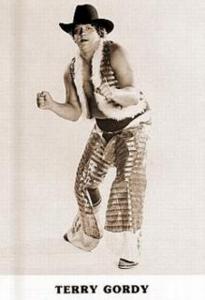
BIO: Terry "Bamm-Bamm" Gordy

Real Name: Terry Ray Gordy

Hometown: Chattanooga, TN

Height/Weight: 6' 3"/297

Signature Moves: Oriental Spike, powerbomb, DDT, lariat and short-arm lariat

WCCW Titles Held: WCCW American Heavyweight Champion, WCCW Texas Brass Knuckles Champion, WCCW Six-Man Tag Team Champion (five times with Michael Hayes and Buddy Roberts, once with Roberts and Iceman King Parsons) and WCCW American Tag Team Champion (with Michael Hayes).

Need to Know Facts: Born on April 23, 1961, "Bam-Bam" was truly the "muscle" of one of professional wrestling's greatest tag teams.

Starting his career at the tender age of thirteen, Gordy debuted as a member of the Masked Scavengers tag team (with Eddie Griffin) in a 1974 telecast from the WRIP-TV studios in Rossville, Georgia.  He later worked as Terry Mecca for Angelo Poffo's ICW promotion, then in Mississippi where he held that state's heavyweight title in 1977-78.

Gordy first met "Lord" Michael Hayes (as he was then billed) after leaving Mississippi in 1978, and the pair teamed in matches throughout the South.  They ended up working for Nick Gulas in Memphis, where they first began to use Lynyrd Skynyrd's Southern rock anthem "Free Bird" as their entrance music.  Working for Jerry Jarrett in Memphis later in '78, Hayes and Gordy officially became The Fabulous Freebirds, but left for Georgia shortly afterward, where they added mat veteran Buddy Roberts, and were involved in a memorable feud with Ted DiBiase and Junkyard Dog.

However, as many wrestling fans know, the Freebirds catapulted to national stardom when they turned on the Von Erich clan in late 1982 shortly after their arrival in World Class, when Hayes and Gordy cost Kerry Von Erich a match against NWA World champion Ric Flair. The historic Freebirds-Von Erichs feud continued until the 'Birds left World Class in 1984 for brief stays in the WWF, AWA, Florida and the Central States territories.  They would return to WCCW for a few months beginning in late 1985.

Gordy would find solo success in Bill Watts' Universal Wrestling Federation, where he became the company's first world champion, beating Hacksaw Duggan in a May 1986 tournament in Houston. Gordy would forfeit the title to One Man Gang later that year following an auto accident.  After the UWF dissolved nearly 18 months later, Gordy again returned to World Class for a short time, then turned his attention to wrestling primarily in Giant Baba's All Japan Pro Wrestling, with former UWF arch-enemy Steve "Dr. Death" Williams as his frequent tag team partner. The pair was known collectively as The Miracle Violence Combination.

Terry Gordy was the first non-Japanese wrestler to win the All Japan Triple Crown, defeating Jumbo Tsuruta on June 5, 1990 in Chiba, Japan. Gordy would lose the titles three days later to Stan Hansen in Tokyo, but won them for a second time on July 17, 1990 from Hansen in Ishikawa, only to be stripped later that month when he was hospitalized following the first of two near-fatal drug overdoses.  He made a full recovery and continued to team with Williams in AJPW, and briefly in WCW during Bill Watts' tenure as president, where they unified the NWA and WCW Tag Team titles.

On August 18, 1993, while on a flight to Japan, Gordy took a massive overdose of Soma (a muscle relaxant) and could not be awakened after the plane landed.  He remained in a coma for nearly a week and,like Mike Von Erich following his bout with toxic shock syndrome, suffered brain damage which adversely affected his performances in the ring for the remainder of his life.

Gordy in his last few years would wrestle on occasion, including a short 1994 stint in the Global Wrestling Federation where he teamed with Michael Hayes and Jimmy Garvin as the Freebirds.  He appeared in the famed King of the Death Match tournament in Japan, losing to Cactus Jack.  In ECW, he feuded with Bam Bam Bigelow over the name "Bam Bam", and again teamed with Steve Williams for several matches.  His last major appearance was in WWE, where he teamed briefly with Mankind in 1996 as the masked Executioner.

Terry Gordy died on July 16, 2001, at the age of 40, from a blood clot in his heart. His son Ray has wrestled on the independent circuit since 2002, keeping the prestigious Gordy name alive in the professional wrestling industry.

BIO: Gorgeous Jimmy Garvin

Real Name: James Williams

Hometown: Tampa, Florida

Height/Weight: 6'0"/237

Signature Moves: Brainbuster

WCCW Titles Held: NWA American Heavyweight Champion (four times), WCCW Texas Heavyweight Champion.

Notable WCCW Feuds: David Von Erich, Chris Adams and Sunshine.

Need to Know Facts: Born on September 25, 1952 in Tampa, Florida, Jimmy Garvin, in only a little over a year, became one of World Class’ most successful wrestling heels. He possessed such an abundance of natural charisma that his antics are still fondly recalled today, some twenty-plus years after his stint with World Class ended.

Jimmy Garvin began his wrestling career in 1972 as Beau James. He soon took the name "Gorgeous" Jimmy Garvin and wrestled along his two "brothers", Terry and future NWA World Champion Ronnie (who is actually Jimmy’s stepfather), whom he briefly managed starting in 1969.

Garvin toured the Mid-Southern and Florida territories from 1978 until 1983. It was during his stint in Florida Championship Wrestling that Garvin first met up with David Von Erich in 1981. David was able to convince Jimmy that Dallas-Fort Worth was a potential hotbed for professional wrestling, and in spring 1983, Garvin joined World Class. Jimmy's original plan was to bring along his wife Patti as his valet. However, Patti was pregnant with the couple’s daughter when Garvin started in WCCW, so taking Patti’s place was Valerie French -- better known to fans as Sunshine -- who actually was Garvin’s first cousin.

Ever the heel, Garvin initially would not allow WCCW cameras to film his matches. He wore white cloth gloves, boot covers and a sparkling bowtie, all of which Sunshine would carefully remove prior to the start of his matches.

Getting his World Class career off to a quick start, Garvin became embroiled in a feud with the promotion's most beloved hero, David Von Erich, over the prestigious Texas Heavyweight Championship. The two gladiators electrified WCCW arenas for most of 1983. Garvin also teamed often with the Fabulous Freebirds in their feud with the Von Erichs.

The most memorable aspect of the wild feud between Garvin and David Von Erich occurred when David beat Jimmy in a match that stipulated that the loser would become the victor’s personal valet for the day. Alas, Garvin and his dutiful valet Sunshine spent the day (in a segment hosted by WCCW announcer Bill Mercer) at Von Erich's ranch digging fence posts, bathing dogs, cleaning horse stalls and bailing hay.

Following his feud with David Von Erich, Garvin next moved on to feud with Chris Adams and, in a highly memorable angle, replaced Sunshine with his wife Patti, who took on the name Precious. Sunshine, who was now aligned with Adams, feuded with Precious while Garvin and "The Gentleman" traded the American Title until July 1984, when Garvin left for the American Wrestling Association (AWA).

In the AWA, Garvin formed a tag team with "Mr. Electricity" Steve Regal, and the dastardly duo soon captured the AWA World Tag Team Titles from the mighty Road Warriors with the help of Garvin’s old allies, the Fabulous Freebirds.

After losing the titles to Scott Hall and Curt Hennig in 1986, Garvin went to work for Jim Crockett Promotions (NWA). He was in the middle of a feud with Magnum T.A. when Magnum was involved in the automobile accident that would end his career.

In 1987, Jimmy's "brother" Ronnie feuded with Jim Cornette and his Midnight Express (Bobby Eaton and new member Stan Lane). During a match with the MX, Cornette threw a fireball in Ronnie's face and Jimmy came to Ronnie’s rescue, becoming an instant fan favorite. Garvin would go on to feud with NWA World Champion Ric Flair and “Taskmaster” Kevin Sullivan.

Garvin would return to NWA action in June 1989 as Jimmy "Jam" Garvin, becoming the newest member of the Fabulous Freebirds with Michael Hayes. Due to backstage politics, Garvin’s NWA return did not last long, although he and Hayes did capture the World Tag Team titles. Leaving WCW in 1993, Jimmy returned to Dallas, wrestling briefly with the Global Wrestling Federation where he reformed the Freebirds with Hayes and Terry Gordy. Garvin and Gordy would win the GWF tag team titles in 1994; however, Garvin would retire to become an airline pilot when the GWF folded in September of that year.

BIO: The Fantastics

Real Names: James Hines (Bobby Fulton); Thomas Couch (Tommy Rogers)

Hometown: Billed from the "City of Angels" (Los Angeles)

Height/Weight: Fulton 5'10"/225; Rogers 5'9"/ 225

Signature Moves: Rocket Launcher

WCCW Titles Held: WCWA Tag Team titles (twice) and WCCW American Tag Team titles.

Notable WCCW Feuds:  The Midnight Express, the Rock & Roll RPM's, John Tatum & Jack Victory.

Need to Know Facts: The popular and talented Fantastics, one of a plethora of classic 1980s tag teams, formed in 1984 in Bill Watts' Mid-South territory, before quickly moving on to World Class Championship Wrestling.

Fulton and Rogers (who began their careers in 1979 and 1981, respectively) worked initially in WCCW with the PYT's (Norvell Austin and Koko Ware), then began a feud with the Midnight Express (then consisting of Bobby Eaton and Dennis Condrey, seconded by manager extraordinaire Jim Cornette) over the WCCW American Tag Team Champions, resulting in many memorable matchups between the two legendary teams.

The Fantastics entered every World Class arena to ZZ Top's "Sharp Dressed Man", looking every bit the part, with sequined vests, bowties, and their "GQ good looks", like their counterparts The Rock 'n' Roll Express. The Fantastics were second only to the Von Erichs as the promotion's resident heartthrobs, with a pre-match ritual consisting of circling around the ringside area shaking hands and receiving kisses from their adoring fans.

The popular duo would return to Bill Watts' Universal Wrestling Federation in 1985, becoming involved in a barbaric feud with the Sheepherders (Luke Williams and Butch Miller). The two teams eventually battled in one of the sport's first ever barbed-wire matches, shedding massive amounts of blood throughout the southern U.S.

Returning to the World Class promotion in 1987, Rogers and Fulton feuded with one of the promotion's top heel tag teams at the time, The Rock & Roll RPM's (Mike Davis and Tommy Lane). The rivalry would culminate with a scaffold match at the Parade of Champions card held on May 3, 1987 at Texas Stadium.  In early 1988, the Fantastics worked a program with "Hollywood" John Tatum and Jack Victory.

Feeling they needed to revitalize their team, Fulton and Rogers left World Class for Jim Crockett, Jr.'s NWA, to continue their feud with Jim Cornette's Midnight Express, which now consisted of Bobby Eaton and Stan Lane.  They would swap the NWA U.S. Tag Team titles with the Midnights during their tenure for Crockett.  After leaving the NWA, they continued to tag on the independent wrestling scene and in Japan, often adding Bobby Fulton's brother Jackie into the mix while keeping their successful tag team name.

Tommy Rogers went onto a have a respectable solo wrestling career in the late 1990's, frequently wrestling in Japan and Extreme Championship Wrestling.  (An interesting side note: Rogers and Fulton actually wrestled each other in the WWF in 1997 as part of a tournament to crown the company's Light Heavyweight champion.)  Fulton became a born-again Christian in October 2003.

In 2005, the Fantastics reformed on the indie circuit for a few matches against their long-time rivals, the Midnight Express.

BIO: Flamboyant Eric Embry

Real Name:  Douglas Eric Embry

Height/Weight:  5'10"/240

Signature Moves:  Piledriver, Neckbreaker

WCCW Titles Held:  WCWA Light Heavyweight Championship (five times), WCWA Tag Team Championship (with Frankie Lancaster), and WCWA Texas Heavyweight Championship (three times)

Notable WCCW Feuds:  Shaun Simpson, Jeff Jarrett, Devastation Inc., Jerry Lawler

Need to Know Facts:  Born Douglas Eric Embry in 1959, "The Flamboyant One" began his career in 1977, working in such territories as Eddie Graham's Championship Wrestling from Florida and Joe Blanchard's Southwest Championship Wrestling (based in San Antonio).

In Florida, as babyface (or good guy) "Nitro" Eric Embry, Eric enjoyed his initial wrestling success, capturing the territory's NWA Florida Television Championship on December 26, 1981 in a tournament.  Florida's TV Title at this time was the second most prestigious singles' belt in the territory.  He would go on to battle the likes of Ray Stevens, Dory Funk, Jr., David Von Erich and others.

While in the Southwest territory, Embry teamed up with the late Ken Timbs (and later Dan Greer), in a tandem known as The Fabulous Blondes.  As a member of the Blondes, Embry would go on to win the Southwest Tag Team Championship on five separate occasions (three times with Timbs, and twice with Greer).

After the Southwest territory dried up, Eric spent the majority of 1985 and 1986 wrestling for Capitol Sports Promotions' World Wrestling Council (WWC) in Puerto Rico.  While there, Embry held the organization's WWC Caribbean Tag Team Championship (twice), the WWC Junior Heavyweight Championship (he weighed in at 225 lbs. at this time), and also the WWC Puerto Rico Heavyweight Championship on two occasions.

Embry entered World Class Championship Wrestling in March 1987, going on to become the promotion's first ever Light Heavyweight champion in September of that year.  He was put into a program with Shaun Simpson with the title exchanging hands between the two grapplers on more than one occasion.

Eric's only pay-per-view appearance came on December 13, 1988 in Chicago, Illinois as part of the American Wrestling Association's Superclash 3, which the AWA co-promoted along with World Class, the Memphis territory (then known as the CWA), and POWW (Powerful Women of Wrestling, run by former GLOW promoter David McLane).  Embry, who had lost the WCWA Light Heavyweight Title to Jeff Jarrett on November 24, 1988 in Jackson, TN, regained the belt from Jarrett in 4:13 on the PPV.  He would hold the title for a little over two weeks before losing it to Cactus Jack Manson (Mick Foley);  however, Eric defeated Manson for the title in a January 4, 1989 rematch, holding it until April 7 of that year when Embry won the WCWA Texas Heavyweight Title.

It was around this time that Jerry Jarrett bought a controlling share of the financially troubled World Class promotion from the Von Erichs and Ken Mantell, and entrusted Embry as his booker. While many fans and wrestlers alike have criticized Embry for pushing himself too hard, it was hard to argue with the results he produced.  "Eric was and is a bright person with tremendous drive and a strong work ethic," Jarrett told WCM. "He was full of good ideas, knew the wrestling history of the promotion, and was willing to make great sacrifice to rebuild the business."

In the last few years prior to Embry taking over the book, the Dallas Sportatorium struggled to reach half its capacity of 4500 after years upon years of selling out.  However, in a relatively short period of time, Embry turned WCCW's fortunes around, and professional wrestling in the Dallas/Fort Worth area was exciting again; and for a change, the promotion's top good guy was no longer a Von Erich -- it was The Flamboyant One!

An angle was soon run where Embry lost a loser-leaves-WCCW bout, and was later brought back into the fold by manager Percy Pringle III via a write-in campaign in order to stop General Skandor Akbar's Devastation Inc. from taking control of World Class.  (In reality, Jerry Jarrett was forced to rename the organization after a dispute with the Adkisson family regarding the sale of the rights to the World Class Championship Wrestling name.)  A match was ultimately set for August 4, 1989 at the Sportatorium, where newfound fan favorite Embry, now seconded by his manager Percy Pringle III, would take on Devastation member P.Y. Chu-Hi (Phil Hickerson, seconded by Tojo Yamamoto) in a steel cage. The match's stipulation stated that the winner would gain controllership of the promotion, a majority share of which was said to be "owned" by General Skandor Akbar and his associates.  To the delight of the Sportatorium fans, Embry was victorious, signaling the end of an era as World Class Championship Wrestling would now be rechristened the USWA (United States Wrestling Association).

Embry continued to wrestle for USWA Dallas until it closed in mid-1991, then performed for a promotion based in Baton Rouge, LA where he would rekindle his feud with Skandor Akbar and his army.

Unfortunately, in late 1992, Eric Embry's wrestling career came to an end due to serious injuries he sustained in a car accident in Kentucky.  He has since worked as a licensed electrician, and regularly communicates online with longtime fans who fondly recall the Flamboyant One's glory days in the squared circle.

BIO: Dingo Warrior

Real Name: Warrior (formerly Brian James Hellwig)

Height/Weight: 6'2"/275

Signature Moves: Gorilla press slam, clothesline, splash

WCCW Titles Held: WCWA World Tag Team titles (with Lance Von Erich), WCWA Texas Heavyweight title

Notable WCCW Feuds: Bruiser Brody, Kevin Von Erich, Rick Rude, Buzz Sawyer & Matt Borne

Need to Know Facts:  Indiana native Jim Hellwig -- whose original goal in life was to become a chiropractor -- received his initial training as a member of the Power Team USA group of bodybuilders.  Although trainers Red Bastien and Rick Bassman (owner of the California-based Ultimate Pro Wrestling promotion) decided to disband the team due to their perceived lack of wrestling ability, two of the four members would nonetheless go on to become superstars of the sport:  Hellwig and Steve Borden, later known as Sting.  The two first came to prominence in Bill Watts' Universal Wrestling Federation in early 1986 as The Blade Runners, with Borden adopting the Sting moniker for the first time, while Hellwig became Blade Runner Rock.

Hellwig made his WCCW debut in late June of 1986 as World Class was scrambling to rebuild its roster after Watts' group, which was making a bid to go national, lured away nearly every headliner whose name wasn't Von Erich.  Renamed the Dingo Warrior for unfathomable reasons, he came in as a heel, first teaming with the Percy Pringle-managed duo of Buzz Sawyer and Matt Borne, then joining Gary Hart's stable and feuding with Pringle and Rick Rude.  He also teamed on several occasions with Abdullah the Butcher to take on the popular tandem of Kevin Von Erich and Bruiser Brody.  After failing to get over as a heel, Warrior was turned babyface in October and soon became co-holder of the WCWA tag belts with Lance Von Erich, defeating Matt Borne and Master Gee.  He was upset by Bob Bradley in the finals of a Texas Heavyweight title tournament the following year, but won the belt from Bradley a few weeks later in a rematch.

Leaving World Class in July 1987, Warrior moved on to the WWF where, after a couple of months of squashing enhancement talent under the Dingo name, he would be repackaged as the Ultimate Warrior.  It was at this time that his frenetic, rope-shaking ring entrance -- which invariably left him thoroughly blown up by the time the bell rang -- was born.  Due to his extremely limited moveset (and also, no doubt, exhaustion from those mad dashes around and into the ring), Warrior's WWF matches were often kept as short as possible.  He also became known for his infamously bizarre interviews, which were intense but largely incoherent.

After feuding for most of 1988 with Bobby "The Brain" Heenan's stable (including Andre the Giant), Warrior, subbing for the absent Brutus Beefcake, beat Honky Tonk Man in ten seconds to win the Intercontinental title.  He would also renew his feud with Rick Rude in 1989.  In the 1990 Royal Rumble, Warrior was eliminated by Hulk Hogan, setting up their World title vs. Intercontinental title clash at Wrestlemania VI.  In what was widely seen as a passing of the torch, and one of the best matches either man had ever worked, Warrior scored a clean pin over Hogan to win the belt.

1991 saw a lengthy storyline in which Warrior and Hogan joined forces against General Adnan (al-Kaissey), Colonel Mustafa (aka Khosrow Vaziri, the Iron Sheik) and Sgt. Slaughter, who had turned heel in an angle designed to capitalize on the Gulf War tensions of that year.  But according to Vince McMahon, just before a handicap bout involving the five men at Summerslam '91, Warrior refused to go on, holding up McMahon for a hefty pay increase.  McMahon agreed to the raise, but fired Warrior immediately after the match.  (Wrestling Observer editor Dave Meltzer, however, has stated that McMahon had actually agreed to renegotiate Warrior's contract about six weeks prior to the event, but later simply changed his mind.)  Warrior was brought back the following April, but was gone again by year's end:  McMahon stated that he had failed a substance test, while Warrior claimed to have quit due to a dispute over pay and marketing rights, and because he was about to be relegated to a midcard angle with Nailz (which McMahon and others in the WWF denied).  In 1993, Jim Hellwig legally changed his name to Warrior, enabling him to retain the rights to the name outside of the WWF.

With the Monday Night Wars heating up in early 1996, McMahon brought Warrior in for a third time in an attempt to boost the WWF's ratings. This time, though, he largely failed to get over, perhaps as a result of those sudden disappearances earlier in the decade; at any rate, he was soon terminated again after no-showing several cards he had been advertised to appear on.

Warrior's last in-ring appearances before his retirement took place in 1998 as part of the "One Warrior Nation" angle, WCW's attempt to incorporate him into their interminable nWo storyline.  Like so many other WCW angles, it was ludicrous, with Warrior magically appearing and disappearing in huge clouds of smoke and, in one infamous vignette, popping up in a mirror as a reflection that only Hollywood Hogan -- and viewers watching at home -- could see.  The angle was designed to build up to a rematch of the Hogan-Warrior Wrestlemania encounter from 1990, which would take place at the Halloween Havoc PPV (and, according to Warrior, was booked for the sole reason of allowing Hogan to get the win back).  Unfortunately, the bout turned out to be an unmitigated disaster that was later described by both men as one of their worst matches ever.  The angle failed to help the promotion recover from its steady ratings slide, and Warrior disappeared from WCW shortly thereafter; he officially announced his retirement from the ring the following year.

In later years, Warrior became a motivational speaker and conservative commentator.  In early 2006 he filed a lawsuit against WWE on grounds that his career had been unfairly depicted in the company's Self-Destruction of the Ultimate Warrior DVD, which was given that title after he refused a request by WWE to assist in its production.  The suit, filed in Arizona, was ultimately thrown out, reportedly because Warrior was no longer a resident of that state (having relocated to New Mexico).  In April 2008 in Madrid, during a ceremony at a Nu-Wrestling Evolution card in which he was presented with an award commemorating his pro wrestling career, Warrior became embroiled in an argument with wrestler Orlando Jordan; as a result, a grudge bout between the two (Warrior's first match in nearly a decade, which -- not surprisingly -- he won) was held in Barcelona, Spain on June 25.

In early 2014, having apparently buried the hatchet with Warrior, WWE announced that he was being inducted into its Hall of Fame, the ceremony taking place the night before Wrestlemania 30 in New Orleans on April 6. Shockingly, 24 hours after an appearance on the following evening's edition of RAW, it was announced that Warrior had suddenly passed away.

Warrior's words on that night's RAW, in retrospect, read like a final farewell to his fans:
Every man's heart one day beats its final beat, his lungs breath their final breath. And if what that man did in his life makes the blood pulse through the body of others and makes them bleed deeper than something that is larger than life, than his essence, his spirit will be immortalized. By the storytellers, by the loyalty, of those who honor him and make what that man did live forever.
Whether one loved or hated his character, Warrior was indisputably one of the most colorful and memorable stars in the history of pro wrestling.

BIO: Missy Hyatt

This summary is not available. Please click here to view the post.

BIO: Gino Hernandez

Real Name:  Charles Wolfe

Hometown:  Highland Park (Dallas), TX

Height/Weight:  6'3"/245

Signature Moves:  Reverse flying elbow drop, Russian leg sweep

WCCW Titles Held:  WCCW American Heavyweight Champion (three times), WCCW Texas Heavyweight Champion (six times), WCCW Texas Brass Knuckles Champion, WCCW American Tag Team Champion (four times: twice with El Gran Markus, once with Gary Young, once with Chris Adams), WCCW Texas Tag Team Champion (three times: once each with Jimmy Snuka, Pak Song and Bruiser Brody) and WCCW Six-Man Tag Team Champion (with Chris Adams and Jake Roberts).

Notable WCCW Feuds: The Von Erichs, Chris Adams

Need to Know Facts:  Born Charles Wolfe on August 14, 1957, Gino Hernandez is perhaps World Class' greatest enigma.

Gino was the stepson of international wrestling star Luis Hernandez (who performed throughout the world as El Medico), whom Gino admired greatly.  However, in 1972, tragedy fell upon Gino's beloved stepfather when he died suddenly of a heart attack while on a wrestling tour in Japan. Understandably devastated by the loss, Gino wanted to drop out of high school to become a professional wrestler in honor of Luis; however, family members and long-time family friend Paul Boesch were able to convince Gino to complete his education.

After Gino graduated from Spring Branch High School in Houston, he quickly entered the professional wrestling ranks at the tender age of seventeen.  Trained by wrestling great Jose Lothario, Gino would wrestle throughout the state of Texas.  However, he would make his first professional claim to fame in Joe Blanchard's Southwest Championship Wrestling.

In the early stages of his career, Gino often teamed with Lothario, before eventually turning on him and joining forces with manager Gary Hart.  This set up the classic wrestling angle of "teacher versus student", which ultimately resulted in Gino losing his hair to Lothario as the result of a hair vs. hair match in Houston.  Shortly afterward, wrestling in Dallas-Fort Worth under the tutelage of Gary Hart, Gino began a feud with David Von Erich over the Texas Heavyweight title.

Gino would return to the Southwest territory in 1982, where along with future Horseman Tully Blanchard, formed the original Dynamic Duo. The tandem was quite successful, holding the Southwest Tag Team titles on nine different occasions.

The duo would split during a 1983 match against the Grapplers, and a big gate program was planned between the two former partners, with Gino playing the babyface.  However, Gino abruptly left the Southwest promotion before the feud really ever took off.  His whereabouts during this period is one of pro wrestling's great mysteries, with individuals speculating as to whether Gino decided to pursue an acting career in Hollywood, or opening a night club in Florida.

Much like his persona in the ring, Gino was living the high life in social settings away from the ring as well. Hernandez was often seen in the trendiest nightclubs, accompanying any woman he fancied (he dated Hollywood bombshell Farrah Fawcett for a time in the '80s), all the while exuding wealth and class for fans and friends alike to see.

Hernandez would make his return to the industry at World Class' first annual Parade of Champions in May 1984, challenging both Chris Adams and Jimmy Garvin for the American Heavyweight championship.  Gino now had WCCW's massive television syndication to display to the world what wrestling fans in Texas (and other Southwestern regions) already knew:  that the "Handsome Halfbreed" was the quintessential professional wrestling heel.  Whether it was a sneak attack on his opponent, having a temper tantrum over a referee's call that had gone against him, pulling a pair of brass knuckles out of his tights, or riling up the ringside fans, Gino knew exactly what buttons to push, and wrestling insiders would later recognize him as a true heat machine.

Aligning himself initially with Jake "The Snake" Roberts, Gino would eventually form another version of the Dynamic Duo with Chris Adams after the "Gentleman" turned heel.  The pair quickly became one of the industry's top tag teams (in an era where legendary tandems like the Road Warriors, the Rock 'n' Roll Express, the British Bulldogs and others were in their respective primes).  The duo had an intense rivalry with the popular duo of Kevin and Kerry Von Erich, and the two tandems spilled blood, while sharing the number of victories.

When Hernandez and Adams took to cutting a few locks of the Von Erich's hair after a victory (as well as the hair of Iceman King Parsons, Brian Adias, Scott Casey and even referee David Manning), the Duo challenged the Von Erichs to a hair versus hair match.

The historic bout occurred at the Cotton Bowl on October 6, 1985 in front of 25,000+ fans.  The Dynamic Duo had their heads shaved in defeat, much to the approval of those in attendance.  Donning masks afterward to conceal their bald heads (and sometimes to interfere undetected in each other's matches), Gino and Chris would continue to feud with the Von Erichs throughout the remainder of 1985.  However, on Christmas night, the Duo's partnership ended at Reunion Arena when Gino refused Adams' tag during a key moment in a match-up against the Von Erichs.

The split resulted in a showdown between the two former partners on January 27, 1986 in Fort Worth at the Tarrant County Convention Center, with a stipulation that the loser of the bout would again lose his hair by means of the infamous Freebird Hair Cream (which in this case was liquid).  During the bout, Gino squirted the purple liquid into Adams' eyes, "blinding" him and causing sheer pandemonium at ringside. WCCW referees David Manning and Rick Hazzard, who took off his shirt to wipe the liquid from Chris' eyes, immediately attended to Adams, while Hernandez squirmed out of the arena.  It was to be Gino's final televised match; after no-showing several cards following this bout, friends and World Class officials began to worry about his well-being.

On February 4, 1986, one of Gino's close friends, along with Manning and Hazzard, discovered Gino's badly-decomposed body lying on the floor next to his bed. Coroners estimated that Gino had been dead for several days, ruling that the cause of death was an acute cocaine overdose.  Some who were close to the situation have suggested that Gino may have been the victim of a "hit", stating that coroners had found eight times the usual fatal amount of cocaine in his system (including a substantial amount in his stomach) at the time of his death.

Hernandez was hated by World Class fans because that was his job, and he obviously did it well. Those who knew him personally, however, have stated that he was a great friend who quietly made visits to Houston hospitals to meet and attempt to cheer up mentally retarded patients, and others in need.

Indeed it appears that the "Handsome Halfbreed" was a complex man...and a star that was dimmed much too early.